The AI Trade Is Splitting in Two — and China Is Forcing the Repricing
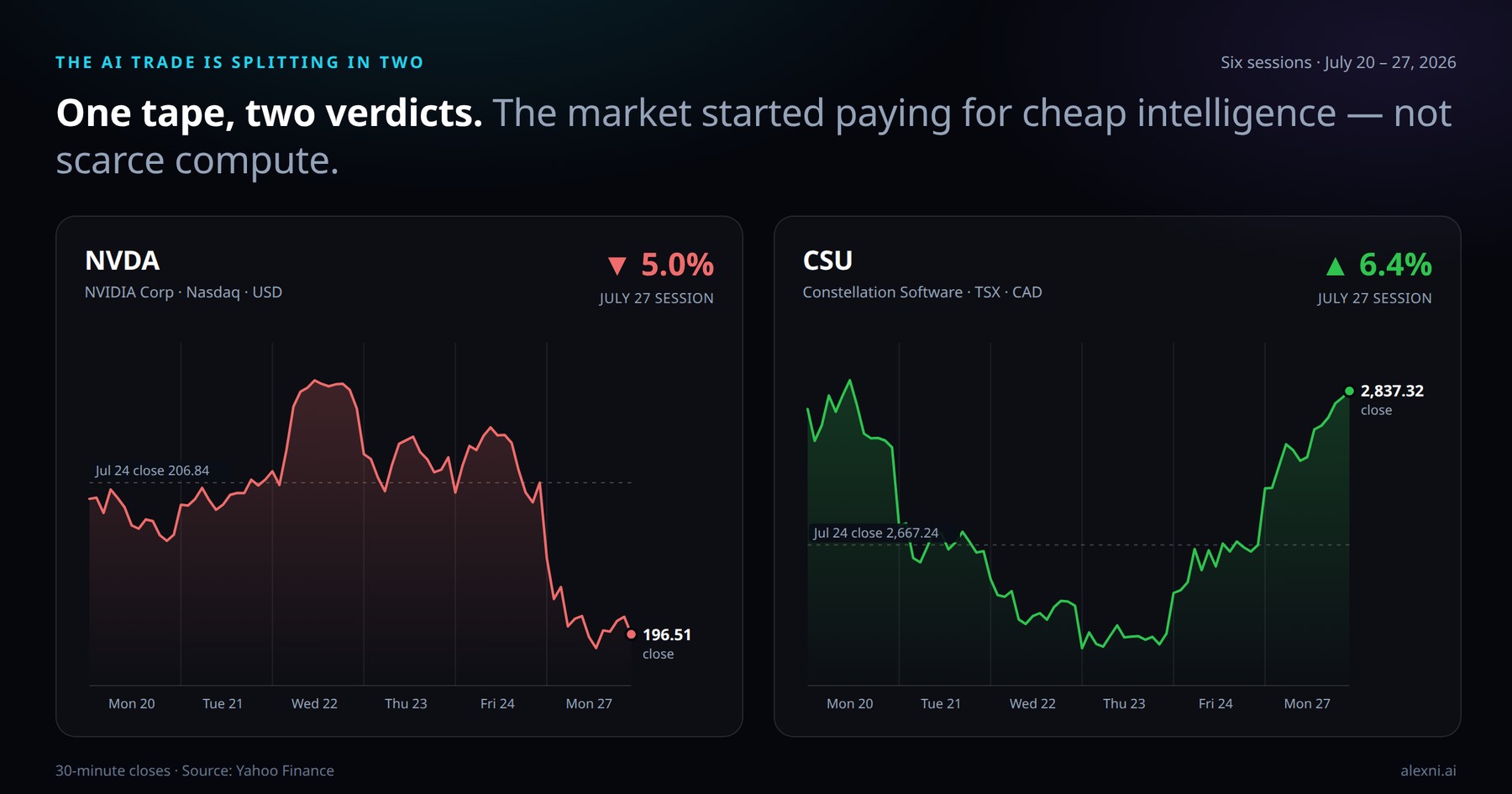
Nvidia fell 5% while Constellation Software rose 6.4%. The market is starting to separate companies that need AI to stay expensive from companies that win when intelligence gets cheap.
For most of the past three years, the AI trade was simple: buy the companies supplying compute, and be cautious about the software companies AI might disrupt.
That trade is starting to fragment.
On July 27, Nvidia fell 5% while Constellation Software rose 6.4%. One trading session does not establish causality. But the contrast captures a broader shift: the market is beginning to distinguish between companies that require AI to remain expensive and companies that benefit when intelligence becomes a cheaper input.
Professor Scott Galloway calls China's strategy "modern-day steel dumping." In June, he put the market implication more bluntly:
This is how the correction/crash begins: AI dumping from China…
Technically, "dumping" is a metaphor here, not a trade-law finding. Strategically, however, Galloway's point deserves attention.
China is not attacking one American product. It is applying pressure across the AI value chain.
China is compressing three profit pools at once
1. The model layer. Moonshot AI's Kimi K3 is a 2.8-trillion-parameter mixture-of-experts model with 104 billion active parameters per token, native vision and a one-million-token context window.
Its official API price is US$3 per million uncached input tokens and US$15 per million output tokens, with cached input at US$0.30. That is far below the premium tiers offered by leading US labs.
K3 is not uniformly better than the best proprietary models, and benchmark comparisons require care. Different models are sometimes tested using different agent harnesses, fallback behaviour and hardware. The more defensible conclusion is that K3 is frontier-competitive at a materially lower posted price.
Its weights are also downloadable under a custom licence. Self-hosting is not free: Moonshot recommends supernodes with at least 64 accelerators, while operators still carry the cost of power, security, inference engineering and monitoring. But open weights give enterprises and hosting providers negotiating leverage that did not exist when the model layer was controlled by a few closed US vendors.
2. The semiconductor layer. China is also moving downstream into the physical AI stack. CXMT, China's leading DRAM manufacturer, raised US$8.6 billion in the largest mainland Chinese semiconductor IPO on record. Its shares rose 466% on their first trading day.
That does not make the valuation durable. It does give Beijing another well-capitalized vehicle for domestic memory production.
Separately, Reuters reported that a state-backed Chinese group has begun producing domestic immersion deep-ultraviolet lithography systems. Initial volumes are small, and the machines remain behind ASML's technology. The near-term threat to ASML is therefore limited. The strategic message is more important: export controls are accelerating China's determination to localize every critical layer of semiconductor production.
3. Access to the Chinese market. China is simultaneously reducing its dependence on foreign suppliers. Beijing is considering approvals for fewer than 200,000 Nvidia H200 chips — less than half the quantity Chinese companies reportedly requested.
Taken together, the pattern is clear:
- Lower the global price of model intelligence.
- Capitalize domestic chip and memory suppliers.
- Build local semiconductor equipment.
- Limit dependence on foreign accelerators.
This is not a single DeepSeek-style shock. It is a sustained attempt to compress Western margins while building a parallel AI supply chain.
The relevant stocks do not carry the same risk
The market often treats "AI stocks" as one trade. They are not.
Nvidia and AMD sell scarce accelerator capacity. Cheaper models are not automatically bearish for either company: lower inference costs can expand the number of workloads and users, increasing aggregate demand for compute. Kimi K3 itself is highly hardware-intensive at scale.
The more material Nvidia risks are different: uncertainty about returns on hyperscaler capex; financial exposure to customers purchasing its hardware; customer concentration; and the gradual loss of the Chinese market to policy and domestic substitutes.
Nvidia's July decline accelerated after reporting that it was discussing roughly US$250 billion in guarantees connected to an OpenAI data-centre lease, plus possible financing for as much as US$350 billion in chip purchases. These are negotiations, not completed transactions. But they raise an important question: how much AI demand is being supported by suppliers financing, investing in or guaranteeing their own customers?
Micron, SanDisk and SK Hynix face a more direct China-capacity question. CXMT's expansion introduces a heavily capitalized competitor into memory — a market where supply discipline has always mattered.
ASML, Applied Materials, Lam Research and KLA face a longer-duration localization risk. China's first domestic tools do not need to match the frontier immediately. They only need to become good enough across progressively more process steps.
Microsoft, Amazon and Google occupy both sides of the equation. They fund frontier labs, sell them compute and distribute their models. Model-price compression may weaken parts of their investment portfolios while strengthening cloud consumption and application adoption.
OpenAI and Anthropic face the cleanest pricing-power test. If enterprises can obtain frontier-competitive intelligence from open-weight models at a fraction of the posted API price, public investors will demand evidence that premium pricing is supported by better outcomes, reliability, security and enterprise integration — not benchmark leadership alone.
And then there is Constellation Software.
Why CSU is coming back
CSU spent roughly nine months in a punishing rerating. The market's concern was understandable: if AI makes software dramatically cheaper to build, what happens to a company that owns hundreds of vertical-market software businesses?
The criticism that CSU was "not doing enough AI" intensified that concern. But it also exposed a misunderstanding of how Constellation operates.
CSU does not run a centralized technology organization that selects one AI platform for the entire group. Its operating companies make technology decisions close to their customers, then share practices through peer networks and internal AI programs. From the outside, that looks less dramatic than a billion-dollar AI announcement. From the inside, it may be the more appropriate architecture for hundreds of specialized businesses serving different industries, regulatory regimes and deployment environments.
At CSU's 2026 annual meeting, management described innovation cycles compressing from months to weeks and potentially days. It also emphasized that customer procurement cycles — particularly in government and regulated industries — remain measured in years.
That distinction is central to the CSU thesis.
AI makes software easier to produce. It does not make distribution, trust, integration, liability acceptance, domain knowledge or customer migration equally easy.
In vertical software, code is only one component of the product. The rest is embedded workflow: industry-specific data; integrations with surrounding systems; regulatory knowledge; implementation and support; long procurement histories; and customer relationships that may span decades.
An AI-native startup can build features faster than before. It still has to win the account, migrate the data, assume operational risk and survive a long sales cycle.
Meanwhile, cheaper models improve CSU's own economics. Every decline in token cost lowers the cost of adding document processing, decision support, support automation, workflow agents and natural-language interfaces across its portfolio.
The market originally treated AI primarily as a lower barrier to entry for CSU's competitors. It is beginning to recognize AI as a lower input cost for CSU as well.
The fundamentals did not follow the share price down
CSU's first-quarter results help explain the resurgence:
- Revenue increased 20% to US$3.181 billion.
- Organic growth was 6%, or 2% after adjusting for foreign exchange.
- Cash flow from operations increased 9% to US$897 million.
- Free cash flow available to shareholders increased 44% to US$733 million.
- Completed acquisitions represented US$809 million of total consideration.
- A further US$786 million of acquisitions had closed or been committed after quarter-end.
The company was not standing still while its multiple compressed.
Lower software valuations may also improve CSU's acquisition opportunity set. That is not automatically bullish: a cheaper target is unattractive if AI is destroying its underlying economics. But few companies have more experience distinguishing durable vertical workflows from fragile software revenue.
The resurgence therefore appears to have four drivers:
- Narrative exhaustion. The market priced a broad "AI eats software" thesis more quickly than the operating evidence developed.
- Fundamental resilience. Revenue, cash flow and acquisition activity continued to compound.
- AI input-cost deflation. Cheaper models improve the economics of adding AI to an installed software base.
- Revaluation of distribution. As model intelligence becomes more abundant, customer access and workflow ownership become relatively scarcer.
What could still break the CSU thesis
The rebound should not be interpreted as proof that AI risk has disappeared. It would serve to watch four indicators:
- FX-adjusted organic growth turning persistently negative;
- customer attrition increasing in AI-exposed verticals;
- AI development and inference costs rising without measurable revenue or productivity gains;
- and acquisition returns deteriorating as CSU moves into larger transactions.
CSU reports Q2 results on August 11. Those operating indicators matter more than whether the stock crosses a technical resistance level.
The AI trade is becoming a value-capture trade
The first phase of the AI market rewarded exposure: chips, data centres, power and anything attached to model scaling.
The next phase will be more discriminating. If model intelligence continues to commoditize:
- frontier labs must prove durable premium pricing;
- infrastructure suppliers must prove that capex produces cash returns;
- semiconductor incumbents must navigate a parallel Chinese supply chain;
- and application companies must prove they own workflows rather than merely software features.
This is why Nvidia can fall while CSU rises without either move being irrational.
Nvidia remains essential to AI computation, but investors are questioning the capital and financing required to sustain its growth. CSU was treated as a victim of AI, but investors are reconsidering whether cheap intelligence may reinforce the value of its distribution, domain expertise and installed workflows.
The CSU rally is not evidence that the AI disruption thesis was wrong. It may be evidence that the market was looking for disruption in the wrong layer.
Where do you expect the largest share of AI value to accrue over the next two years: models, compute or workflow owners?
Sources
- Constellation Software Q1 2026 results
- Constellation Software 2026 annual general meeting (transcript)
- Moonshot AI: Kimi K3 and API pricing
- Reuters: Nvidia's reported OpenAI financing discussions
- Reuters: CXMT's Shanghai debut
- Reuters: China's domestic immersion DUV production
- Scott Galloway's June 2026 comment
Market prices are through the July 27, 2026 close; chart data from Yahoo Finance. This article is analysis, not investment advice.
Enjoyed this? Get in touch or read more on the blog.