EEG for Beginners: a free, hands-on EEG course
Go from zero to reading a raw EEG trace, telling brain from artifact, and running a basic EEG analysis in Python — in about six hours over two weeks. Every figure and exercise uses real recordings you can open in the browser or in MNE.
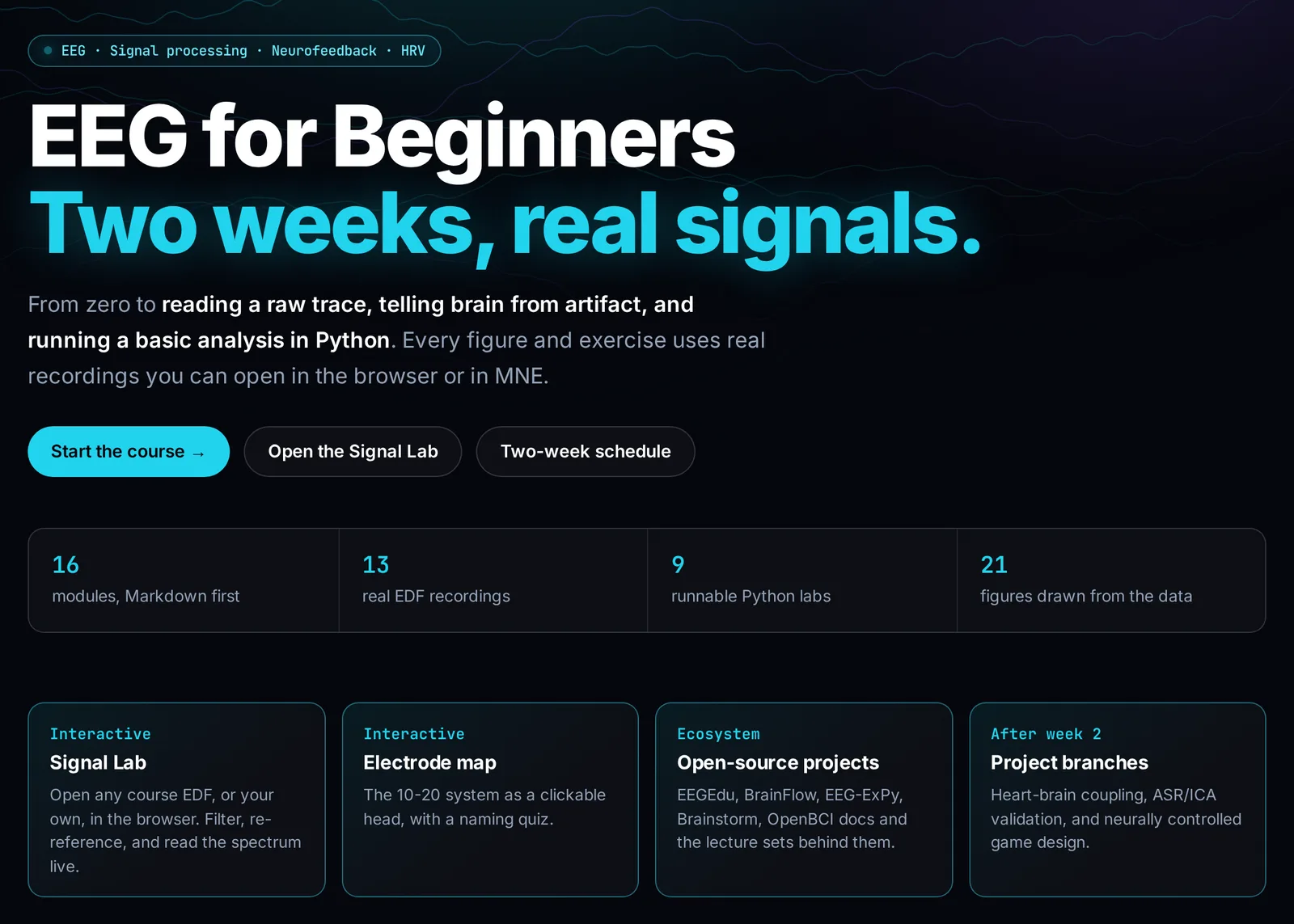
16
Modules
13
Real EDF recordings
9
Runnable Python labs
$0
Free, no sign-up
The basics
What is EEG?
EEG (electroencephalography) records the brain's electrical activity through electrodes on the scalp. It is non-invasive, cheap compared with MRI, and fast: it follows brain activity millisecond by millisecond.
What an EEG measures is the summed post-synaptic activity of millions of aligned cortical neurons, smeared by the skull and scalp. That makes the signal tiny (tens of microvolts) and spatially blurred (centimetres) — which is why so much of practical EEG work is about telling brain activity apart from blinks, muscle, the heartbeat and 60 Hz mains hum.
EEG is described in frequency bands. The edges are conventions rather than laws, but the vocabulary is shared across clinics, labs and neurofeedback systems.
| Band | Range | Associated with |
|---|---|---|
| Delta1–4 Hz | 1–4 Hz | Deep sleep; large slow waves. In awake adults, often a sign of drowsiness or artifact. |
| Theta4–8 Hz | 4–8 Hz | Drowsiness, memory and frontal-midline activity during focused mental work. |
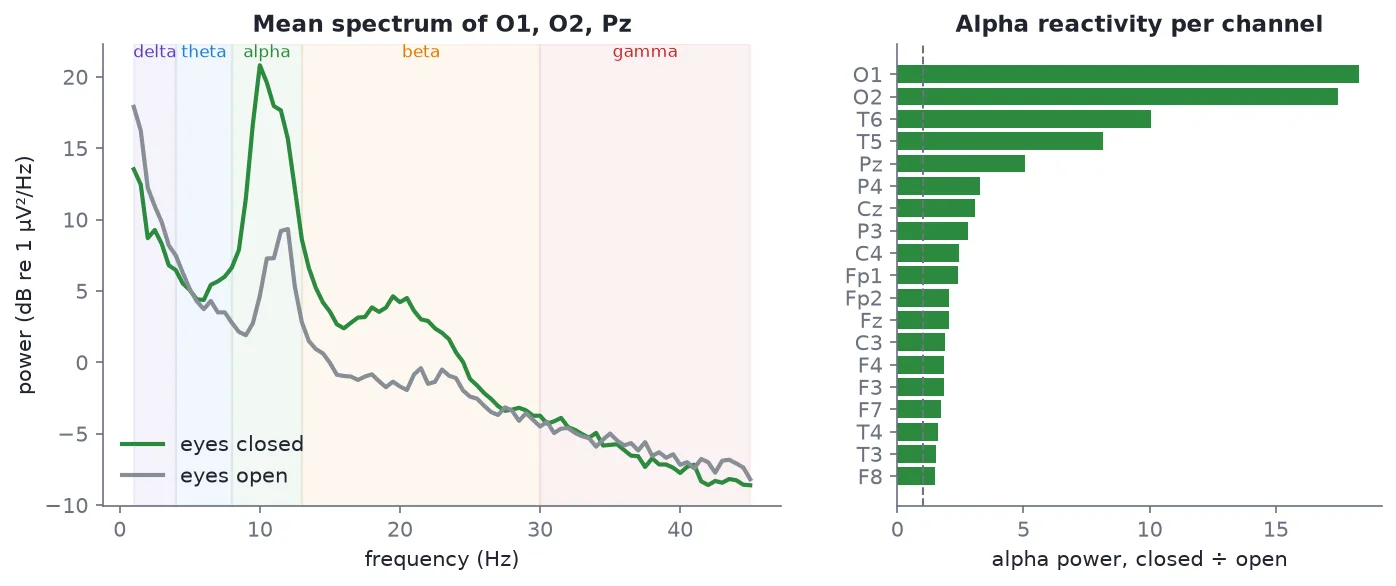
| Alpha8–13 Hz | 8–13 Hz | Relaxed wakefulness, strongest over the back of the head when the eyes are closed. |
| Beta13–30 Hz | 13–30 Hz | Active thinking, attention and motor activity; also where muscle artifact starts to creep in. |
| Gamma30–45 Hz | 30–45 Hz | Fast, low-amplitude activity — and the band most contaminated by muscle and line noise. |
Syllabus
Sixteen modules, two weeks
Week 2 follows the same pipeline, in the same order, that nearly every EEG tool runs: filter, re-reference, remove artifacts, then compute features.
Week 1
What EEG is
- 00
- 01
- 02
- 03
- 04
- 05
- 06
Week 2
Working with the signal
- 07
- 08
- 09
- 10
- 11
- 12Lab 2: clean a recording and measure alpha
Remove a blink with ICA and measure alpha per channel
60–90 min
Applied
Feedback loops
- 13
- 14
- 15
Interactive
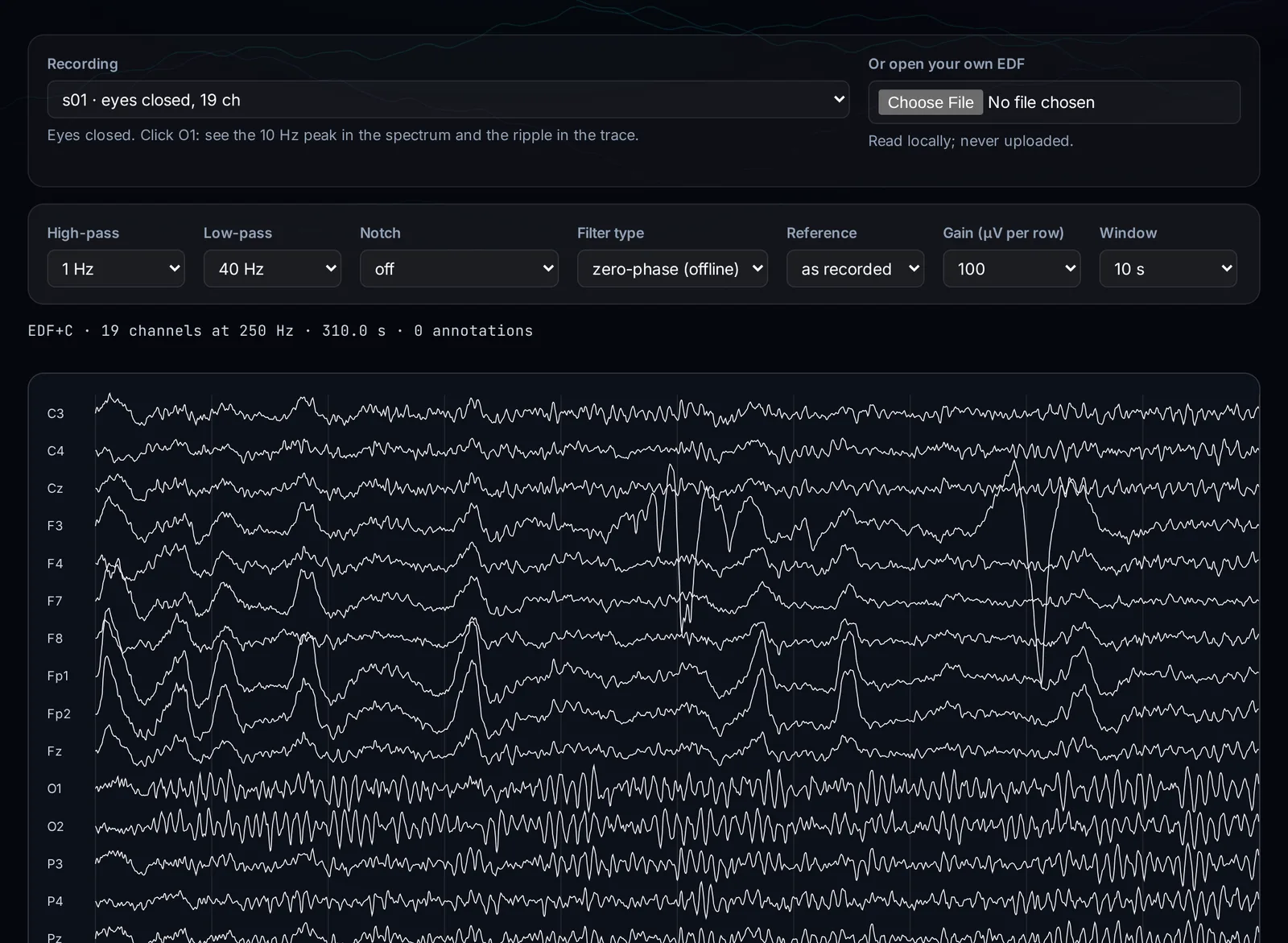
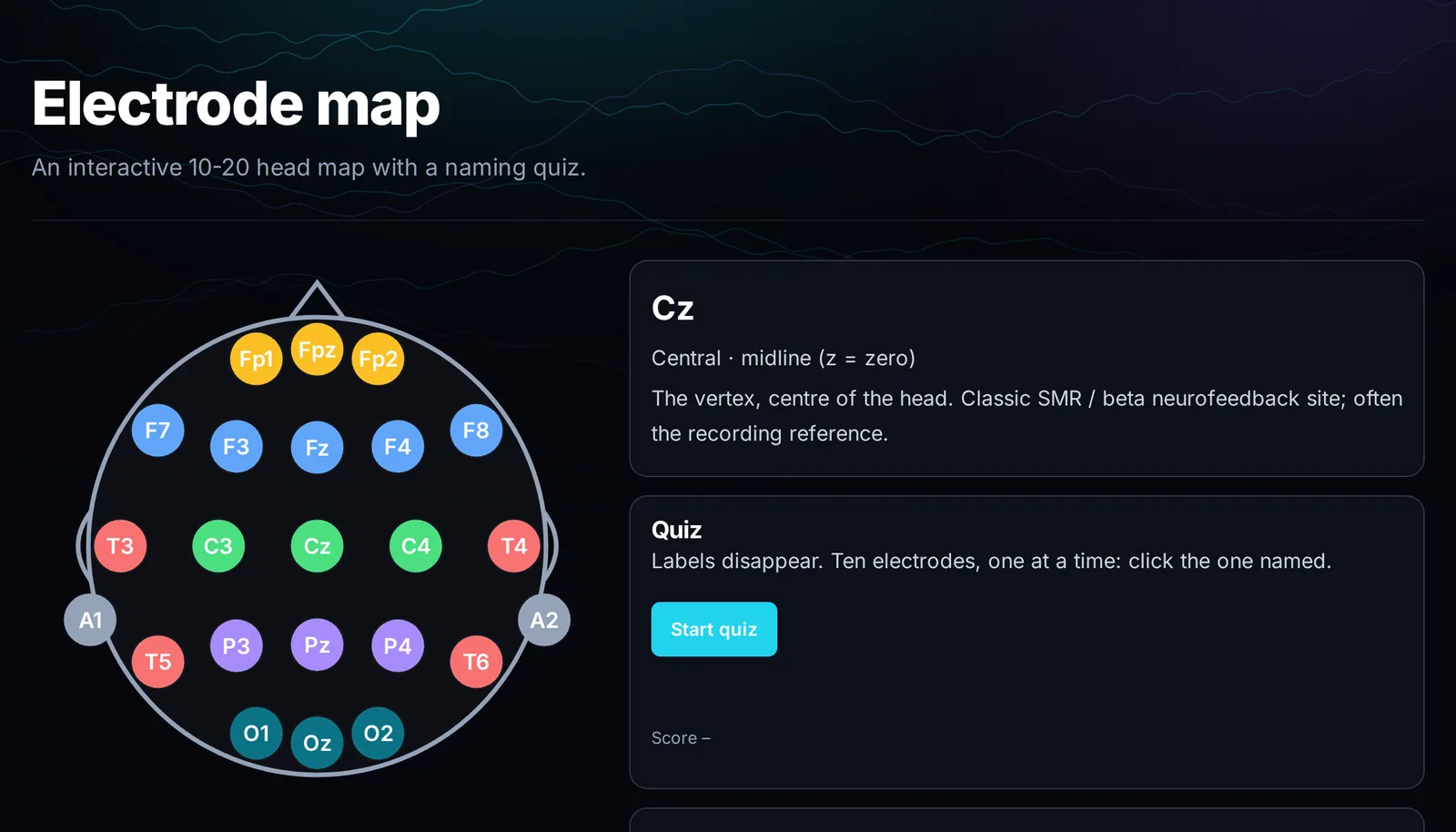
Learn EEG in the browser
Two tools that only exist on the web version of the course. Nothing to install, and your own files never leave your machine.
Real recordings
Most of EEG is telling artifacts from brain
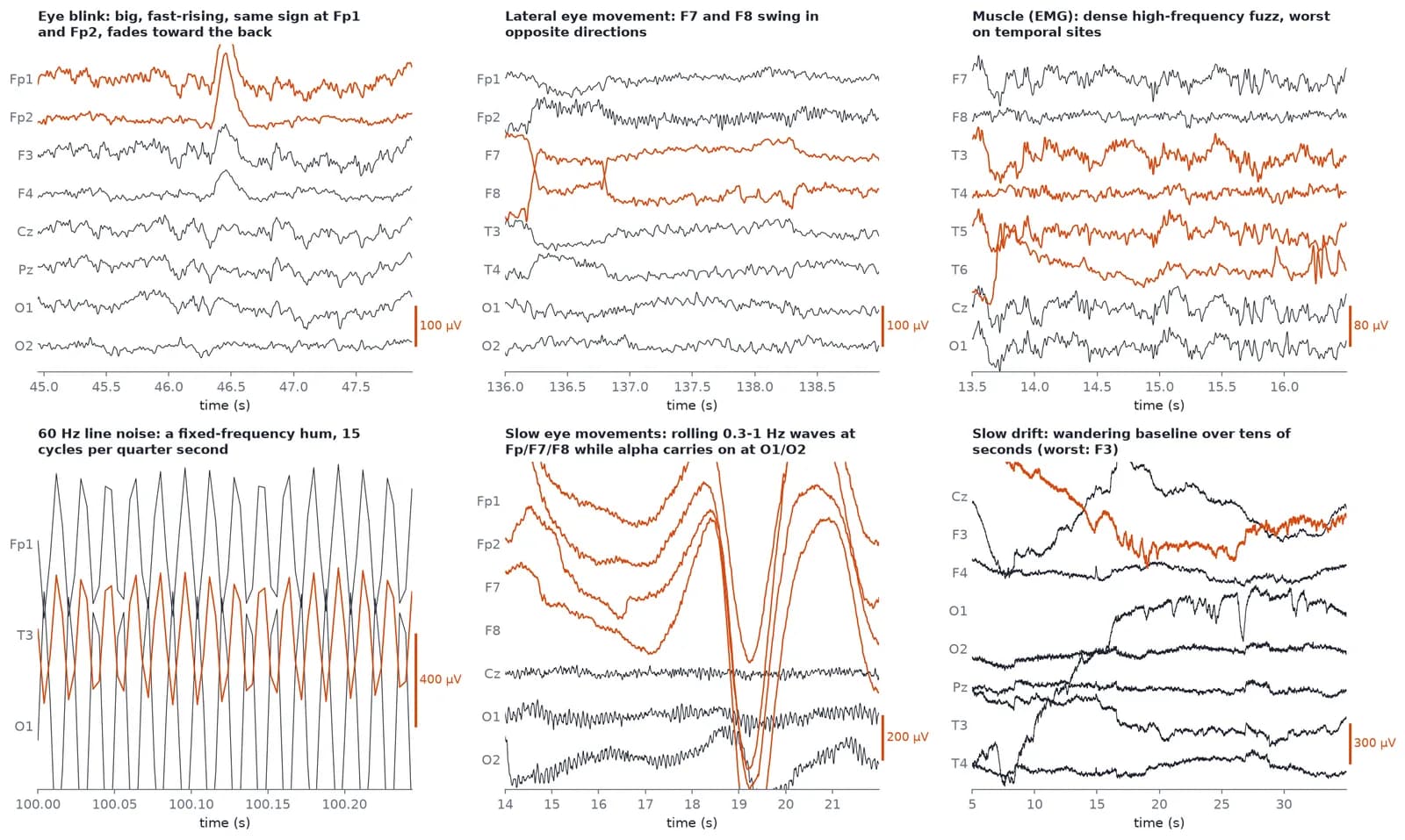
The course is built on thirteen anonymised EDF files from consumer and research headsets, each chosen because it shows something specific: a clean alpha rhythm, a million-fold 60 Hz hum, blinks, drift, and the same recording before and after cleaning. All 21 figures are drawn from them by code in the repo.
- Blinks
- Eye movements
- Muscle (EMG)
- Line noise
- Drift
- ICA
- ASR
Who it's for
Students, engineers and clinicians-in-training with some programming background and no EEG background. It was written to onboard students joining the Divergence Neuro research projects.
What you need
Python, MNE-Python and an editor you already know (VS Code or JupyterLab). Everything linked is free and public: no licences, no sign-ups.
After the two weeks
Project branches go further: heart–brain coupling with EEG and HRV, ASR/ICA validation, and neurally controlled game design.
FAQ
Questions about the free EEG course
What is EEG?
EEG (electroencephalography) is a non-invasive recording of the brain's electrical activity from electrodes on the scalp. What it picks up is the summed post-synaptic activity of millions of aligned cortical neurons: signals of tens of microvolts, with millisecond timing but centimetre-scale spatial blur. EEG is used in clinical neurology, sleep studies, research, brain-computer interfaces and neurofeedback.
Is EEG for Beginners really free?
Yes. The whole course — all 16 modules, the Python labs, the sample recordings and the interactive Signal Lab — is free at learn.alexni.ai, with the source on GitHub. There is no account, no paywall and no licence to buy. Everything it links to is publicly available too.
Do I need a background in neuroscience to learn EEG with this course?
No. The course is written for people with some programming background and no EEG background. It starts from where the signal comes from and builds up to filtering, ICA and spectral analysis.
How long does the free EEG course take?
It is designed as a two-week course of about six hours of core work: eight 30–45 minute sessions plus two hands-on labs of 60–90 minutes each.
What will I be able to do after the course?
Read a raw multichannel EEG trace, tell brain activity from artifacts such as blinks, muscle and line noise, explain frequency bands and the 10-20 electrode system, and run a basic EEG analysis in Python with MNE: filtering, re-referencing, ICA, and band power.
What software do I need?
Python with MNE-Python (the course provides a requirements file), and VS Code or JupyterLab. The Signal Lab and electrode map run directly in the browser with nothing to install, and EDF files you open there are read locally and never uploaded.
Does the course use real EEG data?
Yes. Every figure and exercise uses thirteen anonymised EDF recordings from consumer and research headsets, each chosen to show something specific: a clean alpha rhythm, heavy line noise, blinks, drift, and the same recording before and after cleaning.
Does it cover neurofeedback and HRV?
Yes. The final modules show how filtering, artifact removal and spectral features become a real-time neurofeedback loop, and introduce heart rate variability (RMSSD, SDNN, LF and HF) and how slow paced breathing changes it.
Start learning EEG today
Sixteen modules, real signals, and a Python setup that takes twenty minutes. Free, with no sign-up.